
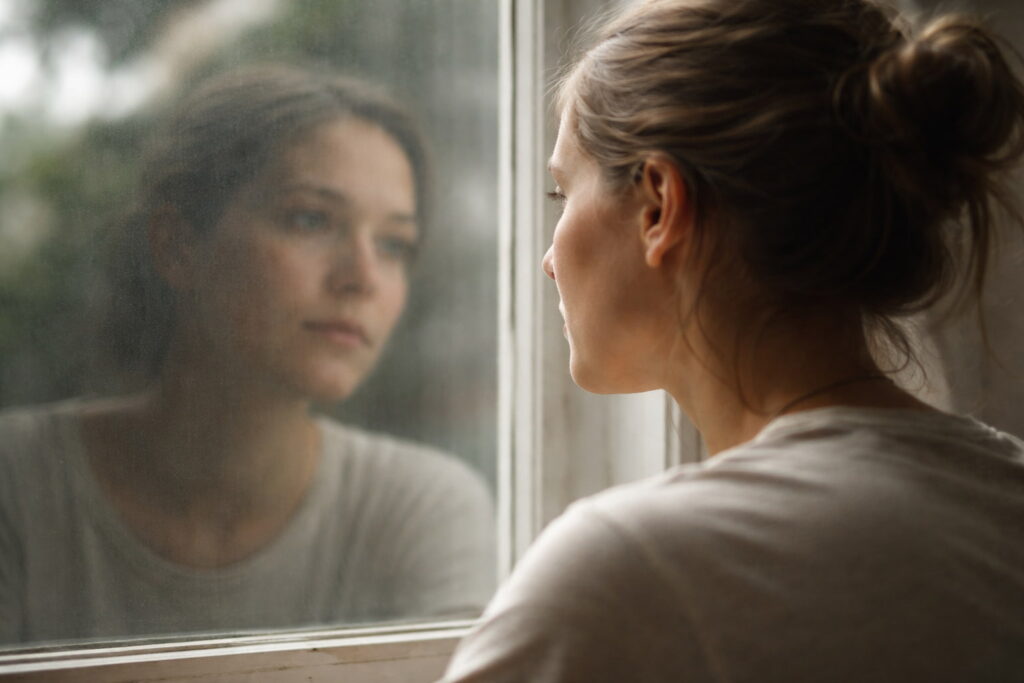
I don’t remember a single clear moment when I decided I wasn’t comfortable with my face. It didn’t arrive as a clear thought or a sudden realization. It grew slowly, like background noise you don’t notice until someone turns the volume up. For a long time, I thought it was just a mood, just a phase, just one of those things everyone feels sometimes.
But the feeling stayed. It followed me into photos, into reflections on glass doors, and into the front camera I avoid opening unless necessary. When I finally tried to explain it to myself, the only honest sentence that came up was this: why I’m not comfortable with my face isn’t about one flaw. It’s about how unfamiliar it feels to live inside it.
Seeing myself is different from being myself
There’s a strange gap between how I experience myself internally and how I look externally. Inside, I feel consistent. My thoughts, my reactions, my silences make sense to me. But when I see my face, especially unexpectedly, it feels like looking at someone who doesn’t fully match that inner version.
It’s not hatred. It’s not even always dislike. It’s more like confusion. I pause, trying to reconcile the person I feel like with the image looking back at me. That mismatch is subtle but persistent, and slowly it creates discomfort. I don’t think this face is ugly. I think, “This face doesn’t feel like me.”
Photographs make the feeling louder
Mirrors at least move with me. They respond in real time. Photographs don’t. A photo freezes one expression, one angle, and one second that I may not even remember living. When I see pictures of myself, especially candid ones, the discomfort sharpens. My first reaction is rarely curiosity. It’s distance.
I study the image like evidence, trying to understand how others see me. Often, I don’t recognize the person in the frame. This is one of the moments where why I’m not comfortable with my face becomes unavoidable. It’s not that the photo is bad. It’s that it feels final, as if it claims to define me in a way I never agreed to.
Other people’s faces feel easier to accept
What confuses me is how easily I can accept other people’s faces. I notice details, asymmetries, tired eyes, imperfect skin, and none of it feels wrong. It all feels human. Familiar, even comforting. But when it comes to my own face, that generosity disappears. I become hyper-aware of angles, expressions, and proportions.
I don’t see a whole person. I see fragments. A jaw that looks heavier than I expect. Eyes that don’t reflect what I’m feeling. This imbalance makes me wonder if the discomfort is less about appearance and more about proximity. I am too close to my own face to see it kindly.
The role of comparison, even when I resist it
I don’t actively compare myself to celebrities or influencers. I don’t scroll and think, “I wish I looked like that.” And yet, comparison still sneaks in quietly. It lives in patterns. In the kinds of faces that are praised. In the kinds of faces considered expressive, confident, and approachable.
Without noticing it at first, these patterns create an invisible standard. Even when I reject it intellectually, my emotional response lags behind. Somewhere in that gap sits the question of why I’m not comfortable with my face, shaped not by direct envy but by long-term exposure to what is repeatedly validated.
Familiarity can sometimes make things worse

People say you get used to your face. I’m not sure that’s always true. I see my face every day, but familiarity hasn’t softened the discomfort. In some ways, it has sharpened it.
I know every small change, every angle that feels off, and every expression that doesn’t land the way I expect. It’s like listening to your own recorded voice too many times. Instead of becoming normal, it becomes more alien. The more I look, the more I analyze. And the more I analyze, the harder it becomes to simply exist without judgment.
Emotion leaves marks I don’t know how to read
Sometimes I wonder if my discomfort comes from seeing traces of things I haven’t processed yet. Tiredness, guardedness, restraint. My face holds experiences I don’t always have words for.
When I look at it, I don’t just see features. I see history. Moments of stress. Periods of silence. Expressions learned as protection. Maybe part of why I’m not comfortable with my face is that it reflects things I haven’t fully made peace with. It shows me more than I’m ready to acknowledge.
When attention makes me self-conscious
Being looked at changes how I feel inside my face. Even neutral attention can make me aware of how I appear. I start wondering what expression I’m wearing, whether my face looks open or closed, tired or uninterested.
This self-monitoring pulls me out of the moment. Instead of being present, I become an observer of myself. Gradually, this creates a subtle tension. My face stops feeling like a natural extension of me and starts feeling like something I have to manage.
It’s not constant, and that matters
The discomfort isn’t always there. There are days when I don’t think about my face at all. Days when I catch my reflection and move on without reaction. These moments matter because they show me the discomfort isn’t permanent or absolute. It fluctuates with mood, energy, and context.
That tells me this isn’t a fixed truth about my appearance. It’s a state. A response. Understanding that doesn’t erase the feeling, but it makes it less heavy. It reminds me that why I’m not comfortable with my face is a question, not a verdict.
I’ve stopped trying to solve this discomfort like a problem. I don’t look for tricks to love my face or force acceptance. That approach only adds pressure. Instead, I try to notice the feeling when it appears. To acknowledge it without immediately arguing with it.
Some days, that means avoiding mirrors. Other days, it means looking directly and letting the discomfort exist without commentary. This isn’t progress in a dramatic sense. It’s quieter than that. But it feels more honest.
What the discomfort has taught me
Living with this unease has made me more attentive, not just to myself but to others. I notice how many people carry similar quiet tensions about their appearance, even when they seem confident. It has softened my judgments and sharpened my empathy. I don’t assume comfort just because someone looks put together. And I don’t assume discomfort is visible.
If nothing else, grappling with why I’m not comfortable with my face has taught me that inner experience and outer appearance are rarely aligned as neatly as we think.
I don’t have a clean ending to this. I’m not writing from a place of resolution. I’m writing from inside the experience, as it continues. Some days are easier. Some aren’t. My face is still my face, and my relationship with it is still evolving.
Maybe comfort isn’t something I arrive at once. Maybe it’s something that comes and goes, shaped by how gently I allow myself to exist. For now, naming the question why I’m not comfortable with my face feels like enough. Not to answer it completely, but to stop pretending it isn’t there.